Blog
Why a QR code should point at your link, not your destination
Published 2026-09-28
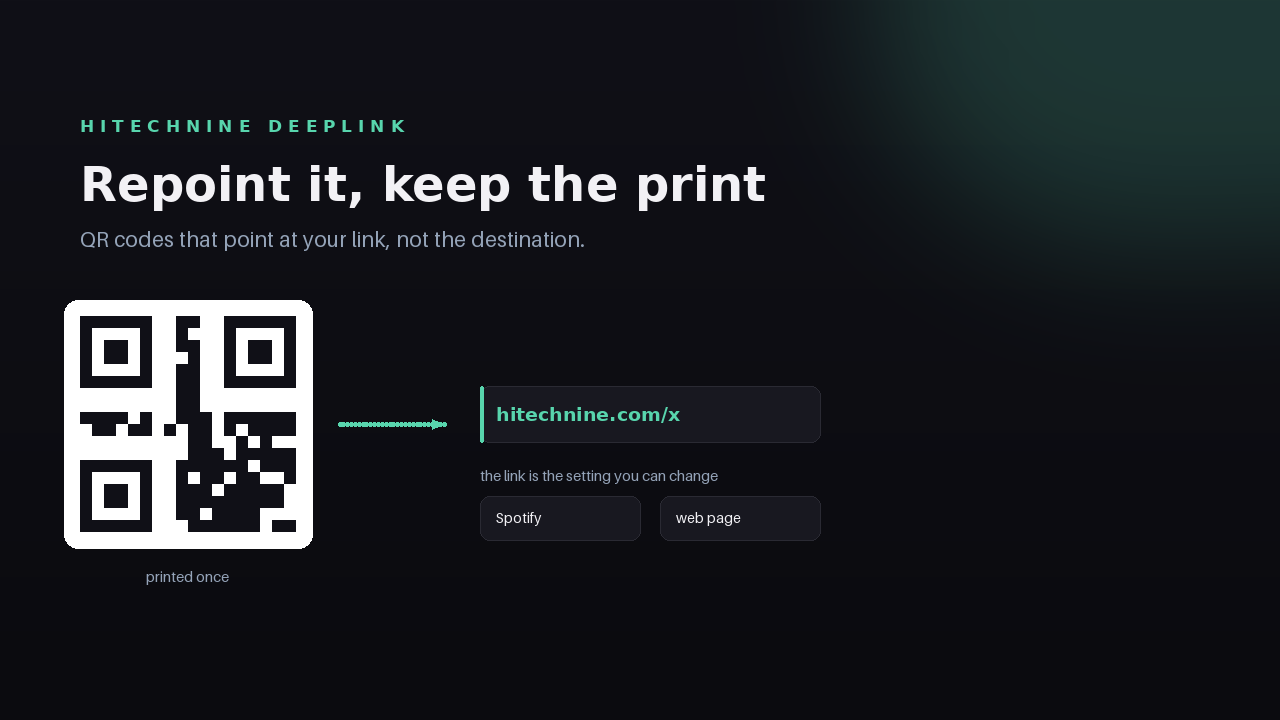
A QR code printed on a poster is a commitment. Whatever it points at is what it points at for as long as the poster is on the wall.
That is fine when the destination never changes. It is a problem in every other case.
Key Takeaways
- A printed QR code cannot be edited. Its destination is fixed the moment it goes to print.
- Hitechnine DeepLink generates QR codes in SVG and PNG that always point at the smart link, never at the final destination.
- A repointed link keeps the same QR code, so old print still works after a campaign changes.
- Campaign parameters, aliases and custom domains make a printed link readable and measurable.
A printed code cannot be repointed
The common mistake is encoding the destination directly: the Spotify track, the ticket page, the campaign URL with its tracking string. It renders perfectly, scans instantly, and becomes unchangeable.
If the track moves, the campaign ends, or the landing page is replaced, every copy of that code is wrong — on the sleeve, on the poster, in the window, on the flyer already handed out.
Point the code at the link
DeepLink generates the QR code against the smart link rather than the destination. The code encodes a URL that resolves per device, and the destination stays a setting you can change later.
The code is provided as SVG for print, so it stays sharp at any size, and as PNG when a raster image is what your layout needs. Nothing about the printed piece changes when the destination does.
Campaign parameters and aliases
A poster and a bio link are different surfaces, and they should not be indistinguishable in the reports. Campaign parameters separate them, so the analytics can tell you whether the print run or the online push is doing the work.
Aliases matter for a different reason: a link you can say out loud. If a flyer, a spoken announcement or a radio slot has to carry the URL, the readable form is the one that survives.
Custom domains
On Pro and above, a link can carry your own domain instead of the platform's. For anything printed, that is the difference between a URL that looks like a sticker on someone else's brand and one that reads as yours.
It also makes the link survive longer in the places where people retype things, and it keeps the printed and the digital material visually consistent.
Reading a campaign as a whole
A release is rarely one link. It is a poster, a story, a mailing, a message forwarded between friends. Collections group links into campaigns so the performance is read together rather than row by row.
That is the difference between knowing a link works and knowing which part of the campaign earned the click.
The Amazon case
For partners selling through Amazon, an affiliate tag can be injected automatically across all 23 storefronts. A listener in Spain and a listener in Germany can both tap the same link and land in the storefront that matches their country, with your tag already in place, without you maintaining a link per market.
One link, tested before print
Before a print run, scan your own code on an iPhone, on Android and with a laptop camera. Check that the fallback page loads when the app is not installed, and that the same code still works after you change the destination behind it. That last test is the one that matters, and it is the one that only a smart link can pass.
Sign in at https://hitechnine.com/login to create a link and generate its QR code.